

Nathan Turner operates the Diversified Mortgage Expo (the DME), and he got my name from a couple of cool people that use my software for their loans. He called and we chatted for a while about what my software does and about life and business. When I talked about having no employees, and how I structure my business so it runs like a well-oiled machine, he said he thought I'd be a good fit for the “Stay Small” topic. He had another speaker, Bill Bymel – founder and CEO of First Lien Capital – that would talk on “Scaling Up” and then I would give a talk on the counterpoint. We each had 20 minutes to speak.
I've spoken in front of crowds of various sizes before, and it's always a lot of fun. The DME is an event primarily attended by people that do things that only a handful of Moneylender users actively do – they buy and sell loans as an investment tool, generally without originating the loans themselves; and they usually hire servicing companies to service those loans. I mostly talk with people that create and service their own loans, so this would be a chance to see a totally different slice of the lending industry. My interest was certainly piqued.
I had about a month to prepare. I started practicing my talk daily, using the treadmill as my 20-minute timer. The first attempts were terribly long-winded. But I distilled some salient ideas and wrote them down on an index card. As the days became weeks, I got my talk to a brisk 20 minutes and had filtered out all the chaff. I made the topics on my index card into a single-slide presentation to put on the screen at the conference while I talked.
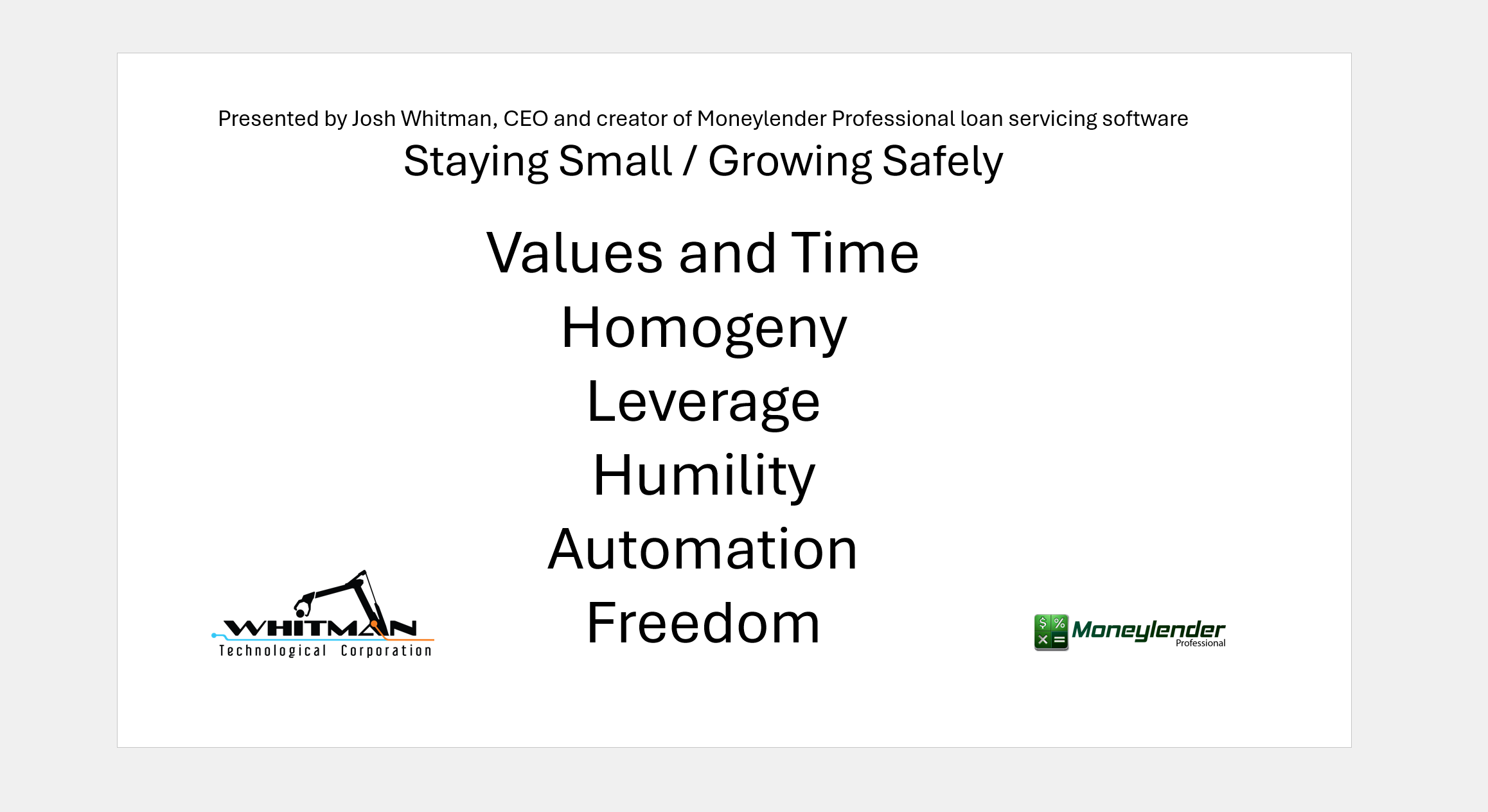 The whole presentation – one slide, six topics, twenty minutes.
The weekend of the conference arrived, and I flew to Nashville for the event. One wild shuttle ride to the hotel from the airport and I met Nathan in person at the registration booth. It was midnight, and I'm no spring chicken, so I crashed out shortly after for the night.
The next morning, I met a bunch of people at the breakfast buffet. People that have been investing in loans far longer than my 22 years providing loan servicing software, and people that were just starting up. They came from all over North America and were dealing with the various local regulations that restrict who and how loans are created and serviced. Vendors had booths set up to show off their businesses – compliance support lawyers, payment facilitation vendors, life insurance vehicles for working capital, real estate investment strategists, retail loan producers, and several loan servicers.
Bill presented the “Scaling Up” side of our topic first. It was funny to note that he touched on a lot of the same motivations that I would be mentioning in my talk. He built an empire for himself, set his sights on some numbers that make me dizzy, and worked his way through the challenges he faced to create a successful business.
Now it was my turn. The sound tech pinned the lavalier mic to my suit and I took the stage. I introduced myself to the crowd of around 160 people.
“We have only one truly meaningful quantity that we can spend – our time.”
If we're going to start a business, it's important that we know why we're in business and what we want to get from the business. So we need to really understand our values. And ultimately, we have only one truly meaningful quantity that we can spend – our time. My business does a job for me, and that job is to let me spend my time with as much autonomy as possible. I spend a couple hours every day with my son. I hang out with him before school each morning, and we watch shows together before bed every night. Sometimes we play video games together, and we roughhouse constantly. I love that dude, and I want to be able to use my time to be with him.
The same is true for my wife. We usually have one or two shows we're watching together throughout the week and we go out on date nights every Friday. We have long talks regularly and there's lots of hugs and love. I love spending time with her. It's important that my business gives me plenty of time to hang out with my family.
I also love technology. My software is fun to develop and support. I'm also building a robot and building the machines I need to manufacture that robot. I love electronics and software and mechanics, and I want to be able to spend time building things. Every Saturday morning, I spend 10 or 20 minutes looking at the waves of Lake Ontario… something about how water moves is a soothing balm to my soul. Rain or snow or wind just makes it that much more interesting.
I want my business to enable me to spend the precious moments of my life on the things that are joyful.
There are two things I've found that have sunk my battleship and those of my friends – homogeny and leverage. Homogeny – when all your eggs are in one basket. When everything's uniform. Something that forms a single linchpin that fails so catastrophically the whole business implodes. For at least two of my collapses, homogeny was the problem. I had one client that was 85% of my company's revenue. It was a real estate developer, and when the market crashed in 2007 all the revenue dried up overnight. I had to reinvent the business, starting from almost nothing, because I was fully depending on one business to continue needing my work indefinitely. Ten years later, I had a contract with the State of South Dakota which was funded by a federal grant. I worked for them for four years when the grant expired. And that was it, there just wasn't a line in the budget for me after the grant ended and I was done. It was a lot of fun while it lasted, though.
“There are two things I've found that have sunk my battleship and those of my friends – homogeny and leverage.”
I had a customer with an office in Christchurch, New Zealand. We had a handful of emails back and forth as he got himself set up on my software. About three months in, he called and asked how to move the software to his home computer – he was going to have to start over, reentering all his loans from memory. He explained that there was a massive earthquake. A lot of people died, and many buildings were badly damaged or destroyed. His office was in a building that was now condemned and he didn't have any other records of his loans elsewhere. Thanks to him sharing his experience with me, I have all my production data both on my server in the Midwest USA and on my local server at my home in New York state – 1500 miles apart, on four hard drives. It would take a lot of synchronous, unrelated failures for that data to become inaccessible. My source code is similarly backed up to a cloud service and on multiple hard drives at home.
The second thing that's taken me down multiple times is leverage. I'll define leverage as any time I put a commitment on my future time. Signing a three year contract for commercial internet access – I'm committing to produce the money needed to cover that contract. Providing free customer support for my software indefinitely. Borrowing money, of course, lets me do something now that future me will have to deal with. Promising to speak at a conference, fun as it is, is a commitment on my time that I have made and prevents me from choosing at every moment what I do. I doubt my life would be meaningful if I didn't plan and promise my time occasionally, but every time I make a promise, I must ultimately pay the price with my time.
“When I had six employees was when I was the least successful with my business.”
I ran myself out of business with payroll more than once, too. I promised to pay people for their time, which meant the business needed to bring in more money to cover that extra pay. When we didn't bring in the extra business, I couldn't cover payroll and I defaulted on my mortgage and I had my water shut off and my sewer shut off and I lost 20 pounds because I couldn't afford food. When I had six employees was when I was the least successful with my business.
But I've seen much more spectacular collapses because of leverage. My real estate developer friend that I was doing all the work for in 2005 and 2006. His business was carefully thought out, with lots of contingencies and plans to make sure assets and revenue and equity and processes were doubly and triply resilient to risk. Over perhaps six years he built out a 186-home subdivision – a mix of single family homes and townhomes. He would borrow the money from banks to build phase one. He would sell them to buyers and use that money for phase two. And then phase three and finally phase four. When he sold the last of the houses, the profit would pay off the banks and leave nine figures of profit for him and his friends to share. It was well thought out and verified by the full spectrum of business and financial professionals. And yet, the world moved out from under him. The housing market collapsed while he was in the middle of phase two. Buyers were forgoing their $1000 earnest money and cancelling their purchase contracts. The market shrank and nobody new was stepping up to buy a home. The contractors that were roughing phase three needed to be paid, and so did the people trimming phase two. The foundations were getting poured for phase four, and the financial engine meant to power the whole thing – sales of completed houses – had just blown all its pistons.
My friend owned over 200 rental homes, and one of his contingencies was to rent any units he couldn't sell in case the market wasn't able to absorb 50 or 60 new homes becoming available every ten months. But now he had 80 brand-new or almost completed rental homes and there wasn't enough demand for rental housing to fill the unexpectedly high availability. Units sat empty, houses were left incomplete. Contractors' invoices went past the net-30 due dates and work on partially built houses stopped. The exposed bones of half-built houses sat unprotected in the weather.
My friend is a man of tremendous integrity. He used the only currency he still had access to in those painful days after the housing crash. He paid those contractors with his rental houses. “These properties have a net equity equal to what I owe you. They're yours now. They are rented and that rental income is yours. When the market rebounds, you can sell these properties if you want the equity. Until then, I'll continue to manage them and keep them rented at no cost to you.” Eventually, the contractors were convinced to send their crews back out to finish the remaining phases, seeing that it was better to work with an honorable man with the guarantee of future pay than to sit idle in a time when work was scarce. I watched my friend's nine figure empire collapse because the market failed like a tsunami that would affect everyone in its path.
I have another, even worse, example. When I was making websites for small businesses, one of my first customers sold tractors. A man and his wife bought the tractors and kept them on the 5-acre lot where they lived. People would buy the tractors online and he would load 'em up and deliver them to the customer anywhere within a couple states of Arizona. Because they had no overhead, it was a highly profitable side-hustle. They both worked full-time jobs and he delivered tractors on the weekends. He came to me to build a good-looking website for his tractor business.
Google AdWords was brand new back then, and not many industries had caught on yet. We set up a campaign with monthly spend of around $80. His sales tripled almost instantly. He went from delivering one or two tractors a month to making two or three deliveries every weekend. He took over his AdWords account and I didn't hear much from them for a few years.
One evening, I got a call from him and he asked me to “take the site down right now.” I did and asked what was up. He just said there's a problem and I didn't pry. A few days later, they were on the front page of the local paper (we were still in ye old newspaper days) that his wife had been arrested for fraud.
During those three years, they bought commercial property with a little office and moved their tractors onto it. They hired a few staff and quit their other jobs. Quietly, they had turned almost pure profit into a high-leverage business. When other tractor dealers started using AdWords, the cost per click grew to match the value that could be extracted from the marketing for a bulky commodity. As sales decreased, the thinning margins finally went negative. With a new commercial mortgage, payroll, and no other employment to fill in the gaps, things started looking bleak. In a lapse of judgement, they submitted the application for financing on a new tractor purchase from a customer that decided not to make the purchase – a fraudulent loan application. They made the payments on the loan for a time, and ultimately applied for more loans under other customers' names. Then they couldn't even make the payments on the loans they created and that's when people started getting collections letters from the tractor manufacturers. Confused about why they were getting letters when they never bought the tractor, the fraud quickly rose to the surface. Increasing leverage against the future had finally pushed them to break the law. The wife ended up serving four months in jail.
“I always wanted to be THE guy. Now I see that I'm A guy.”
And that's why humility is next on the list. I imagined myself a great entrepreneur. I thought my wit and compassion and work ethic would overcome any obstacle. Through my own bitter failures and the painful experiences of my friends I learned to see myself differently. I always wanted to be THE guy. Now I see that I'm A guy. Just like everyone else, and hardly a force to have much impact on things. Even the most powerful people are swallowed up in things bigger than they can control. So little old me needs to always remember that I'm not destined for victory or wealth or fame. My destiny is just to live the life of a human, same as everyone else. I'm not in charge. I'm not in control. I have to pay attention to those early warning signs that my friends and I failed to heed as we headed into our biggest catastrophes. I'm not so big that I can stop the market from turning, the industry from changing, the economy or the world from doing things that disrupt my status quo.
A normal workday for me starts by checking the email that came in overnight. Usually takes about 5 to 10 minutes. Then I review the payments in my AutoPay service to see if anyone did something goofy – perhaps another 5 minutes. And then I do whatever I want for the rest of the day until 4:30PM. That's when I run the daily payment batch. I push four buttons on an admin console, and a process runs for about 5 minutes. Aside from the (welcome) phone call or email from someone with questions about Moneylender, I do whatever seems interesting in the moment. I can hang out with my wife or my son if I want, make robot parts in the basement, develop cool software or anything else I want to do.
I want to clarify that I often spend 20 hours a week or more on Moneylender related things. It's a project that gives me a lot of joy. It's exciting to have so many people finding utility and benefit from something I made with my own two hands. It's a complicated problem, and the solving of it has spent tens of thousands of hours of my life. It is a gift that keeps on giving. The one thing I built in my career that other people use daily.
So how can I run a business that profits six figures and takes only fifteen minutes of my life? Automation! Automation comes in many forms. Some of the obvious ways my business has automation – people can download and run my software without my involvement. They can buy and activate licenses instantly. They can revoke and reissue their licenses for my software automatically. My system emits the exact numbers I need to report taxable sales in NY state. I have a system that I can upload a year of transactions from each of my bank accounts into and it spits out the numbers I need for my annual tax returns. I spend exactly two days of accounting total to do my taxes each year for my S-Corp and my personal returns. Payroll taxes take about 30 minutes every three months. All my bills are scheduled for automatic draft and autopay.
I didn't get to that point by accident. I chipped away at it slowly for two decades. First I learned what I needed to do. Then I figured out how to do it. Then I got sick of the more boring parts of doing it, so I found creative ways to streamline the worst of it. Eventually, my streamlining got better and better until the task is almost imperceptible.
The same process applies to everything about my business. I do all my own customer support. If someone has a question, they call and we figure out the answer together. It's interesting to see what sort of stuff people are doing with my software. If another person has the same question, it's quick and easy to point to the answer I discovered with the previous customers. If ten more people have that same question, it gets a lot less fun to answer the same thing over and over. So I figure out how to automate it. Maybe it's a complicated process like RESPA's escrow management rules, and I handle more of the math internally or show the interim steps more prominently. Maybe I can add more structure to my software, so people get their answer before they really think to ask. Maybe I need to make it easy to find a video that explains a complicated topic right at the point where someone's going to want that information while using my software. Maybe it's a billing question and I should add or rephrase something in how my invoices and receipts are written.
“The single biggest customer service point of pain had been eliminated and was replaced with a revenue stream.”
In 2022 I was on the phone for 8 to 10 hours a day for all of January and most of February as people did their 1098 forms and got their tax numbers together. It was a grueling marathon of helping people untangle numbers after they got confused, helping them relearn how to enter payments in the program after they went a year without updating their records, and most of all, helping people send 1098 forms to their borrowers. Maybe a third of the calls were people telling me the numbers for the interest and principal balances were wrong. This last group are people that haven't read the actual instructions from the IRS, which specify that the interest should include late fees but not other fees, and that the balance is from the start of the year or start of the loan if originated during the year, not the balance at the end.
So I spent a good chunk of my time redesigning the 1098 experience into a step-by-step wizard. I registered with the IRS as a data furnisher and added the ability to send 1098 forms directly to me and I'll file them with the IRS for you. I posted the info about the interest and principal boxes everywhere in my user's guide and videos that someone might find themselves when doing their 1098s. The next year, the phone was eerily silent, emails trickled in, but lots of people paid me to file their 1098s. The single biggest customer service point of pain had been eliminated and was replaced with a revenue stream. It turns out, the automation wasn't just worth something to me – it was something my customers were happy to pay for, too. Doing 1098s for my users went from a mess to a highly guided 5-minute process.
To sum it all up: keep promises to pay time and money small; bring in revenue from lots of people in lots of industries and locations; add some geographic resiliency to your business operations; don't get too big for your britches; find ways to solve problems at the source so they stop consuming your attention. Do this and increasing chunks of your life will free up for you to spend doing the things that bring you joy and fulfillment.